Building Your First AI Stack: Start Small, Think Strategically
Begin with one tool, one task, and one practical need.

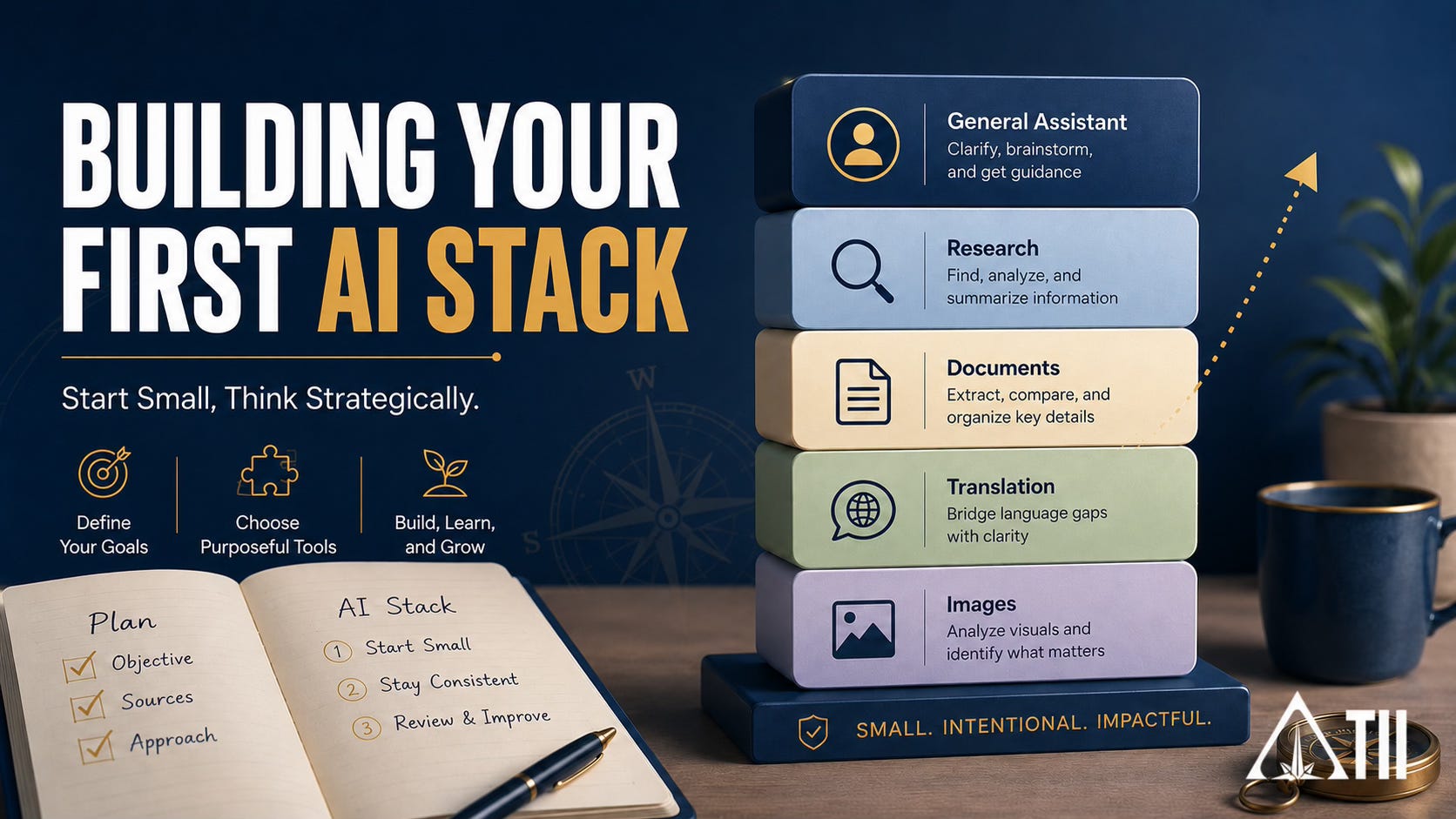
Building an AI stack does not mean collecting every new platform or creating a complicated system.
It can begin with one tool, one task, and one practical need.
An AI stack is simply a small, purposeful collection of AI tools chosen to support different types of work. One platform may assist with drafting, another with research, and another with a recurring task such as translation, transcription, document review, or image analysis.
The goal is not to build the largest stack. It is to build one that reflects how you actually work.
Begin with Your Recurring Tasks
Before comparing platforms, look at the work you already do.
List the tasks that regularly consume time, require repeated effort, or could benefit from additional support. For an investigator, these might include:
Developing search terms
Reviewing lengthy reports or case material
Locating publicly available sources
Translating or transcribing content
Organizing findings
Comparing information across sources
Drafting or refining reports
Examining images or other media
Do not begin by asking which AI platform is most popular.
Begin by asking:
Which recurring task would I like to support more effectively?
This creates a practical starting point and prevents the tool from defining the work.
Choose One Task to Test
Select one familiar, low-risk task that you understand well enough to assess independently.
For example, you might test a tool by:
Summarizing a public report
Generating alternative search terms
Reorganizing notes into categories
Drafting a preliminary outline
Translating non-sensitive public content
Familiar material makes it easier to judge whether the tool is genuinely useful. You are more likely to notice omissions, weak reasoning, awkward phrasing, or incorrect details when you already understand the subject.
The purpose of the first test is not to prove that the platform is impressive. It is to learn how it behaves.
Start with One Accessible Tool
Your first tool does not need to be expensive or highly specialized.
Start with one platform you can easily access. Learn how it responds to different instructions, how much context it can manage, and what types of output it produces consistently.
Pay attention to practical questions:
Does it understand the task?
Does it follow the requested format?
Does it produce useful results?
Where does it require more guidance?
Does it save meaningful time?
What errors or limitations appear?
This experience will tell you more than a feature comparison alone.
A tool may perform well for drafting but poorly for source discovery. It may summarize clearly but struggle with complex documents. It may be useful for brainstorming but less suitable for precise factual work.
These observations help define the tool’s role within your stack.
Give Each Tool a Clear Role
As your stack grows, each tool should have a reason for being there.
A simple stack might include:
A general-purpose assistant for drafting, brainstorming, summarization, and structured thinking
A research-oriented platform for source discovery and current-information searches
A long-document tool for reviewing reports, policies, transcripts, or case material
A specialized tool for translation, transcription, imagery, coding, geospatial work, or another recurring need
Not everyone will require all four categories. Some people may use one tool for several months before identifying a genuine reason to add another.
The roles also do not need to be rigid. Some platforms will overlap.
What matters is understanding why you are using each tool and what value it contributes.
Add a Tool When You Identify a Gap
Do not add another platform simply because it is new, popular, or receiving attention.
Add one when your current tool does not support an important task well enough.
An investigator may begin with a general-purpose assistant for organizing research questions and drafting search plans. Over time, stronger source discovery may become necessary, making a research-oriented platform useful.
Later, if interviews or videos become a recurring part of the work, a transcription tool may earn a place in the stack.
That is a deliberate progression:
Start with one need. Test one tool. Identify a gap. Add with purpose.
Ask:
What can this tool help me do that my existing tools cannot do well enough?
If the answer is unclear, the tool may not yet have a meaningful role.
Keep a Simple Comparison Record
You do not need a complex scoring system when you begin.
A short record can help you compare tools based on actual use rather than memory, marketing, or promotional claims.
For each tool, note:
The task tested
What the tool did well
Where it struggled
Whether the output was useful
Whether it duplicated an existing capability
Whether the time or cost was justified
This helps distinguish between a tool that is interesting and one that is genuinely useful.
Build a Stack, Not a Pile
A stack is intentional.
A pile is accumulated.
A useful AI stack is built around recurring tasks, defined needs, and clear roles. Each tool contributes something specific.
A pile may include overlapping platforms, unused subscriptions, or tools added without a clear purpose.
The distinction is not technical. It is strategic.
The aim is not to create complexity. It is to create clarity.
Review and Refine
Your stack should evolve as your work changes.
Platforms add features. Pricing shifts. Privacy terms change. Existing tools may become more capable or less suitable.
Periodically ask:
Do I still use this tool?
Does it continue to solve a defined problem?
Has another platform replaced its role?
Is the cost still justified?
Removing a tool can be just as strategic as adding one.
Start Small, Think Strategically
The strongest AI stack is not necessarily the largest.
It is the one in which each tool has a clear role, supports a genuine task, and contributes practical value to the workflow.
Begin with one recurring need. Test one accessible tool. Learn what it does well. Notice where it falls short. Add another only when a genuine gap becomes clear.
Toddington International’s 105E AIO — AI for OSINT course supports this process by helping investigators assess where AI may assist, compare tool capabilities and limitations, and evaluate suitability and risk for specific OSINT tasks.
The tools will continue to change.
The ability to choose them deliberately will remain valuable.